POETRY and Acceptance
So I have been reading a bit of contemporary poetry lately, mainly for research purposes. I’ve always been interested in defining things—things like novels, or music, or in this case poetry—and even more interested to observe how other people define them.
You see, someone defines poetry in the way he approaches it. For example, a man who thinks poetry is a rhymed group of words will write a rhymed group of words when he goes to write a poem. And though he might think what he has written is a poem, that may not be the case. Not all poems are true poetry, in the same way that not all paintings are art. There is a standard to be met, or there should be.
Contemporary poetry leans toward simplicity—of the bad sort. In the past century free verse has become the most popular form, and poems themselves have degenerated, it seems, to simple prose constrained to poem structure. Besides its structure, which usually feels contrived anyway, there is nothing terribly poetic about most contemporary poetry.
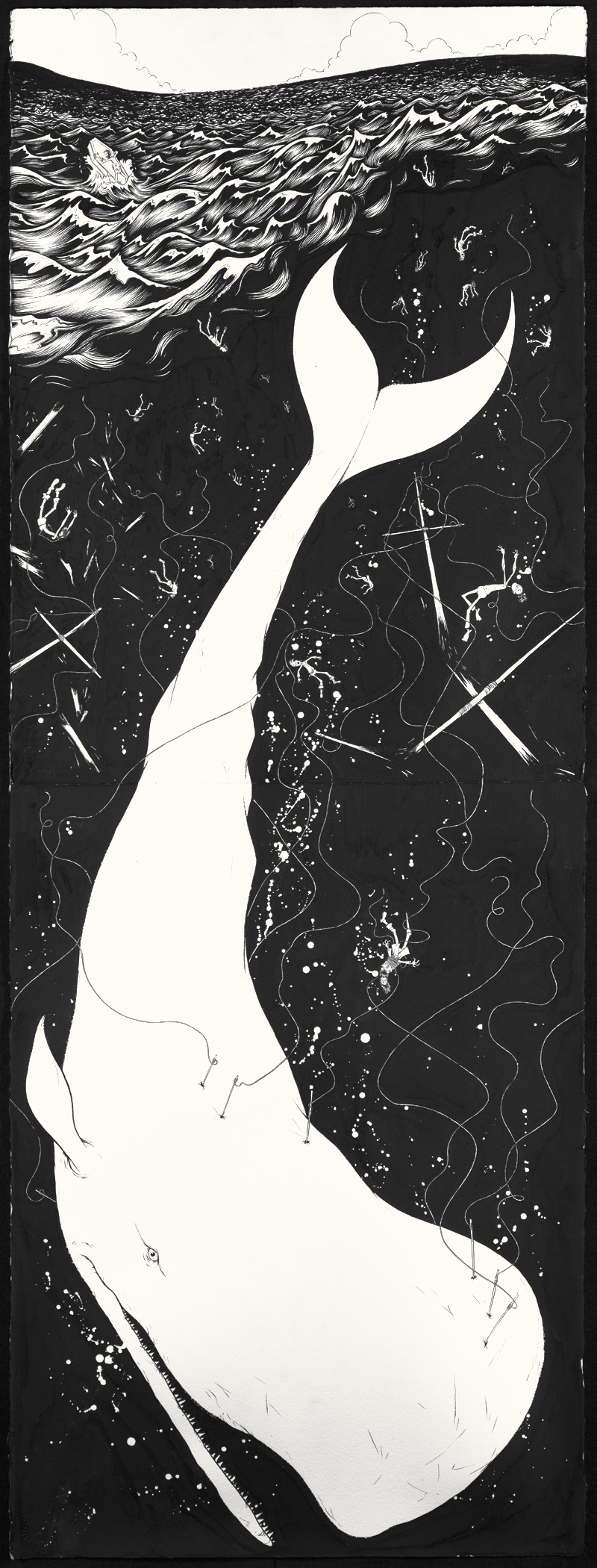
To illustrate this idea, I opened Moby Dick and blindly set my finger on a paragraph. I copied the paragraph, which is two sentences long, and formatted it in free verse form. I have to say, what I ended up with is, in my opinion, better poetry than what I’ve been reading. Melville wrote with his ear, his rhythm is distinct and easy to follow:
With a long weary hoist,
the jaw is dragged
on board, as if
it were an anchor;
and when proper
time comes—some few days
after other work—Queequeg,
Daggoo, and Tashtego,
being
all accomplished dentists,
are set to drawing teeth.With a keen cutting
spade, Queequeg
lances the gums; then
the jaw is lashed
down to ringbolts,
and a tackle being rigged
from aloft,
they drag out these teeth,
as michigan oxen
drag stumps of old oaks
out of
wild wood-lands.
I would say this is close to true poetry, but it has nothing to do with my formatting. The prose of Moby Dick is poetic in style, so I’m hardly surprised this paragraph turned out well. At any rate, it was never meant to be a poem, and yet by today’s standards this is definitely poetry because of its format. Or, more likely, because it purports to be poetry and must be accepted as such.
Acceptance is a popular idea these days. Some people I know would be offended by this article if they read it, because I might have the audacity to tell someone his poem is a bad one—or even not poetry at all. In their opinion his poetry should be accepted as poetry, good or not, and the fact that he tries to write is more important than what he writes, he shouldn’t be criticized for its quality. The problem with this broad, all-inclusive idea of acceptance is that standards are compromised. If all poems are poetry, and should be called beautiful because they’re all beautiful in their own poetic way, then beauty becomes meaningless, and the work of the great poets inconsequential.
“We read and write poetry because we are members of the human race, and the human race is filled with passion. Medicine, law, business, engineering, these are noble pursuits and necessary to sustain life. But poetry—beauty—these are what we stay alive for.”
(I haven’t actually watched Dead Poets Society, but I do watch Apple videos.)